The useful question is not how many ideas you can collect. It is what fits this child, this room, and this moment. Start with one bounded choice, then use the rescue or stop instead of forcing it.
Start here: Adult clears and watches one short floor lane. Skip if you cannot attend to every child who can reach it. Roll one soft sock ball toward a nearby low basket, not over its rim; walk to reset. Stop for throwing, running or anyone entering the lane. Check the local fit and stop note before starting.
This chooser reconciles current extension, education, and publisher sources with Kid Activity Lab editorial guidance. Kid Activity Lab has not family-tested these setups. Fit, timing, mess, engagement, enjoyment, learning, repeatability, and safety outcomes are unknown.
Check the real room and every child who can reach it
Check every child who can reach the setup, not only the intended preschooler. Clear one defined area away from stairs, doors, pets, breakable objects, and active walkways. Remove damaged materials. If any child may mouth a piece, use larger solid materials, stay within reach, and watch continuously. Choose the direct supervision and stopping point the actual room and child require.
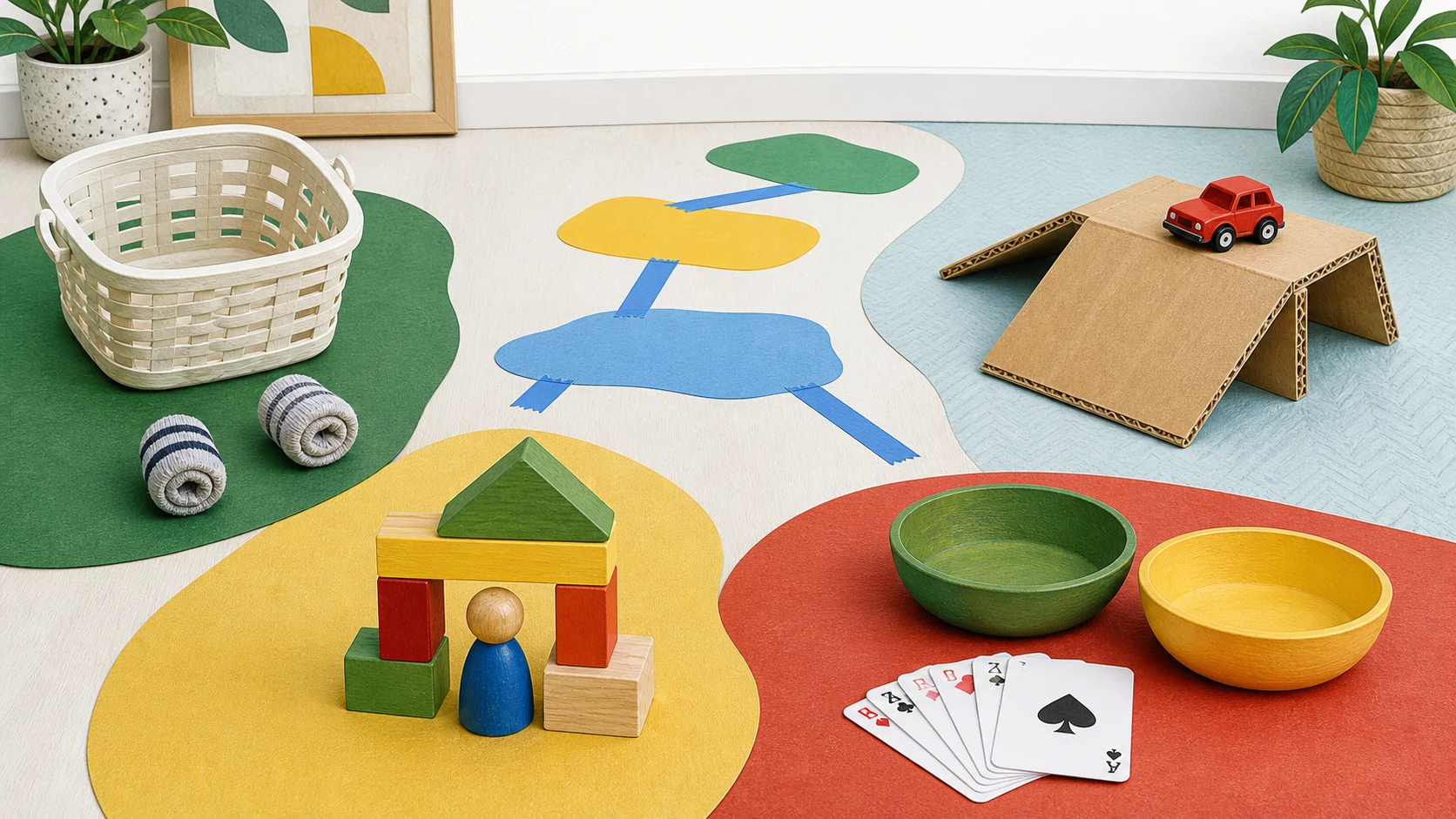
Kid Activity Lab illustration of five indoor activity routes. It is not a family-test photo and does not show measured use.
A table or clear floor area; standard cards and the players named by the game
Choose a game by player count and manage the rules and ending
Rainy day is a context
Rotate the job, not the page
Weather may be why everyone is inside, but the next useful choice is still movement, making or building, quieter play, or a game. Rain-themed crafts and weather learning are separate jobs and are not promised here.
These four moves are Kid Activity Lab editorial guidance. They reduce the decision and setup, but they do not predict how a child will respond.
Define the footprintName the one table, floor square, or short lane the activity may use. Keep doors and walkways open.
Give one child-facing jobSay the next visible action: roll to the basket, cross the puddles, deliver the toy, or make a place.
Rescue by shrinkingMove the target closer, use fewer pieces, shorten the path, or finish one wall. Do not add a bigger explanation.
Stop and clearUse the named stop, remove loose materials, and return the room to an ordinary walking space.
Six bounded starts
Choose one child-facing idea
Use the rescue as a smaller finish. Use the stop when the material, movement, room, or child no longer fits.
Move in one lane
Soft-Sock Target Roll
Stop: Stop for throwing, running, mouthing, a loose sock, discomfort, or anyone entering the lane.
Parent check: Clear a short floor lane away from stairs, doors, cords, breakables and walkways. Stay beside every child who can reach it; skip if you cannot watch them all. Try when the child can release along the floor and pause on request. Research-backed, not family-tested by Kid Activity Lab.
Kid idea: Roll one soft sock ball toward a nearby low basket. Touching the target is optional; do not try to roll over the rim.
Editorial preschool route
Needtwo clean soft socks, one low empty basket
Adult setup: Use socks only, without ties or hard fillers. Push one sock into the other's toe and fold the cuff over it into a soft ball with no trailing fabric. Put the empty basket on the floor nearby. It is a target to roll toward, not a rim to roll over. If the ball comes apart, stop and remake it.
Put the sock ball on the floor.
Roll gently toward the basket; touching it is optional.
Pause, then walk to collect the ball and reset.
If it stallsIf aiming stalls, bring the basket closer or gently roll to an adult partner instead. No basket? Use that partner-roll option in the same clear lane. Take turns one at a time; do not lengthen the lane beyond adult reach. End by putting away the socks and basket and clearing the floor.
Stop: Stop and clear the path if paper or tape lifts, the path slides, running starts, or the route reaches a doorway or walkway.
Parent check: Before making the path, check the floor and spacing yourself. If you cannot watch every child who can reach it and stay close enough to stop the route, skip this start.
Kid idea: Travel across three or four large paper shapes using one movement the adult names.
Editorial preschool route
Needthree or four large paper shapes, painter tape suitable for the local floor
Adult setup: Test the tape, secure every shape flat, and keep the path short enough to supervise from one position.
Stand beside the first shape.
Step onto each shape using the named movement.
Walk around the path to reset.
If it stallsUse two shapes within one easy step and ask for one crossing.
Time not measuredMess not measuredAdult handles all tape
Adult role: choose the surface and vehicles, apply and remove all tape, and stay beside every child who can reach the setup. Skip if you cannot do this.
Child's choice: drive and park, point, watch or decline.
Research backed; not family tested by Kid Activity Lab. Duration, mess and physical outcomes are unknown.
Stop: Stop for mouthing, throwing, damaged pieces, blanket bunching or slipping, running, climbing, feet on the route, blocked paths, lost adult attention or unwanted collapse.
Parent check: Check owned toy and block age/warning labels for every child who can reach them. Use intact large lightweight pieces without loose small parts, magnets or battery parts. Clear a low floor area away from doors and walking routes; the blanket must stay flat. State that the route is for the toy, not for feet. Stay beside every reachable child and keep spares away. Try when the child can place with help and follow a stop cue; watching or pointing is an option. Skip if parts, space or attention do not fit. Research-backed, not family-tested by Kid Activity Lab.
Kid idea: Help a hand-carried toy cross a tiny pretend river near one blanket edge, not the blanket's full width.
Editorial preschool route
Need1 flat blanket, 3 large lightweight blocks (2 low supports and 1 longer span), 1 large lightweight toy
Adult setup: Choose a tiny crossing near one blanket edge, not across its full width. Check two low wide blocks can sit a short gap apart with the longer block resting on both. Do not force a span that does not fit; use a flat toy path instead.
With adult help, place the two low supports and rest the longer block across both.
Carry the toy in your hand over the tiny bridge and back; keep its weight in your hand, not on the bridge.
Put the toy back at the start. Repeat the pretend crossing or finish.
If it stallsIf the span does not fit, lay blocks flat as a path for the hand-carried toy; do not add height, widen the gap or use force. Adult may move the toy while the child watches or points. Adult puts away the blanket, blocks and toy, clearing the walking area. Duration and mess have not been measured.
Sources checked October27,2026. Block bridging and pretend props are source-backed. This tiny near-edge blanket story, owned-piece selection, hand-carried toy, adult script, stop and cleanup are Kid Activity Lab editorial adaptations, not a tested setup or load test. Source photos do not show this exact blanket arrangement. Physical fit, stability, blanket slip, family understanding, enjoyment, learning and safety outcomes are unknown. No product recommendation or safety assurance.
Choose a deeper route
Use these existing pages when the job is specifically a longer build, a standard-deck game, or finding something from materials already visible.
These sources support parent-job, category, and activity-shape decisions within the limits shown. They do not establish that Kid Activity Lab ran these setups or measured their fit, timing, mess, safety, engagement, or learning outcomes.
PBS Kids for Parents: Rainy Day ActivitiesBroad publisher hub used to confirm that rainy day is a context spanning movement, making, games, and media rather than a second copy of indoor ownership.