Three ways into STEM

STEM activities for preschoolers.

Choose the kind of question that fits what you have now: change a shadow, test a bridge, or continue a pattern. Each bounded start is complete on this page; the deeper routes carry the longer science, engineering, and math jobs.

Choose one way to investigate

Choose by the action the child can take and the materials you can supervise now.

Evidence note

This chooser combines current Head Start, TERC, Smithsonian Science in Pre-K, and NAEYC sources with Kid Activity Lab editorial guidance. Kid Activity Lab has not family-tested these setups. The activity selection, readiness cues, materials, scripts, substitutions, and stop points are editorial choices. Timing, mess, comprehension, engagement, enjoyment, learning, repeatability, frustration, and safety outcomes are unknown.

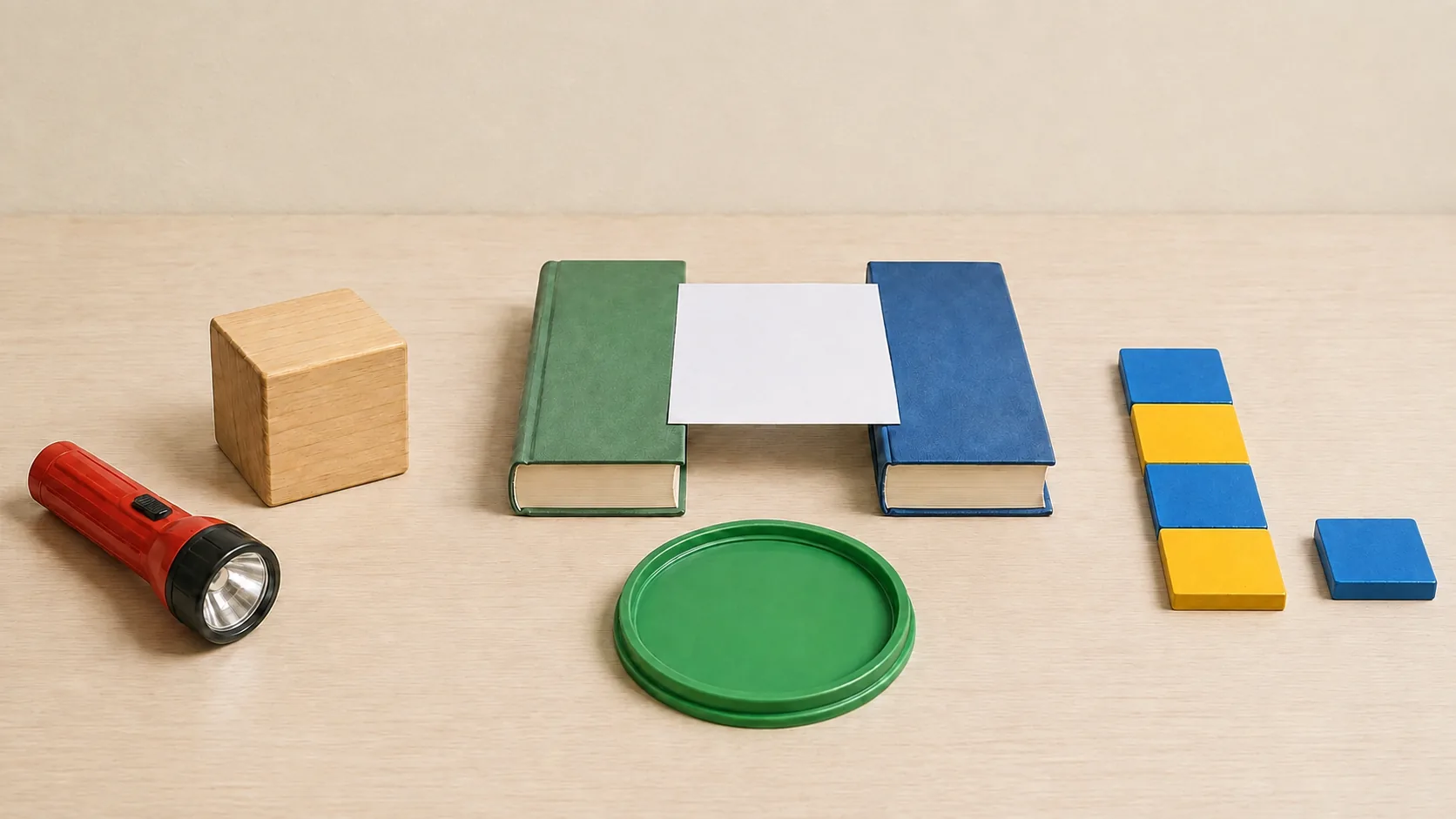
Three illustrated preschool STEM material sets: a flashlight and large block facing a blank wall; a paper bridge across two closed books with a large plastic lid; and four alternating blue-and-yellow pieces with one loose blue piece ready to continue the pattern.
From left: science shadow materials, engineering paper-bridge materials, and math pattern materials. Kid Activity Lab AI-generated illustration; not a family-test photo or evidence of measured use or outcomes.

Three complete starts

Run one question, then stop

Use the readiness cue before the age label. Each start ends after one comparison; continuing is optional, not an expected outcome.

Science | Observe a change

Shadow Builder

Kid mission: Move one large object closer to and farther from the light to make one larger shadow and one smaller shadow.

Materials or substitutea flashlight, one large opaque block or household object, and a blank wall

Substitution: No block is needed; use one large opaque household object that is easy to hold and does not break.

Readiness: Use this start when the child can follow a one-step stop cue and move one large object while the light stays still. The adult operates the flashlight if the child points it toward people or cannot leave it stable.

Adult setup: Put the flashlight on a stable surface pointing at the wall, dim only enough to see the shadow, and keep the walking path clear. Do not aim the light at a face.

  1. Put the object between the light and the wall.
  2. Move the object closer to the light and notice the shadow.
  3. Move it farther from the light and compare the two shadow sizes.
Stop and resetStop after the two contrasting shadows or sooner if the light will not stay pointed at the wall. Switch off the light and restore the walking path.

Engineering | Build and test

Bridge Rescue

Kid mission: Span the gap, test the flat paper, then fold the paper once and compare one stronger version if the first bends.

Materials or substituteone sheet of paper, two broad closed books, and one large lightweight object such as a block, plastic lid, or toy

Substitution: Use a large lightweight plastic lid or block if no suitable toy is available. Keep the two closed books as the low supports.

Readiness: Use this start when the child can place one sheet across a gap and release one light object without lifting, climbing on, or striking the books. The adult owns the supports and ends the setup if that boundary does not hold.

Adult setup: Put one book flat on each side of a short floor-level gap and keep both supports low and stable. The child places the paper and tests one object.

  1. Lay the paper across the short gap.
  2. Set the large light object on the middle, then lift it off.
  3. If the paper bends, fold it once, span the gap again, and compare one more test.
Stop and resetStop after one flat and one folded test. End sooner if the books become climbing, throwing, or finger-trapping objects; return the books and paper when done.

Math | Compare and continue

Pattern Path

Kid mission: Add the next piece, say or point to the repeating part, and extend the path once.

Materials or substitutetwo colors or types of large blocks, tiles, household objects, or adult-prepared paper squares

Substitution: Use any two visibly different kinds of large pieces that are appropriate for the youngest child who can reach them.

Readiness: Use this start when the child can match two visibly different pieces and place one next item. If repeating is not yet manageable, switch to matching two alike pieces and do not call that result a completed pattern.

Adult setup: Start an A-B-A-B sequence with four pieces, name the two parts once, and ask what comes next without supplying the answer immediately.

  1. Look across the four-piece A-B-A-B start.
  2. Choose the piece that comes next and place it.
  3. Say or point to the repeating part after placing the one next piece.
Stop and resetStop after one correct extension or one supported retry. Collect every loose piece at cleanup.