Pick a small problem, give the child a clear mission, test the build, and change one thing. These research-backed challenges use household materials and show the adult job without taking over the design.
Start here: Start with Paper Bridge: two low books, one sheet of paper, and one toy car. If the paper bends, fold it once and test again.
Evidence note
Kid Activity Lab created this chooser from current source and search research. We have not family-tested these setups. The age range, adult roles, rescue steps, and first changes are editorial guidance; timing, mess, engagement, learning, repeatability, and safety outcomes are unknown.
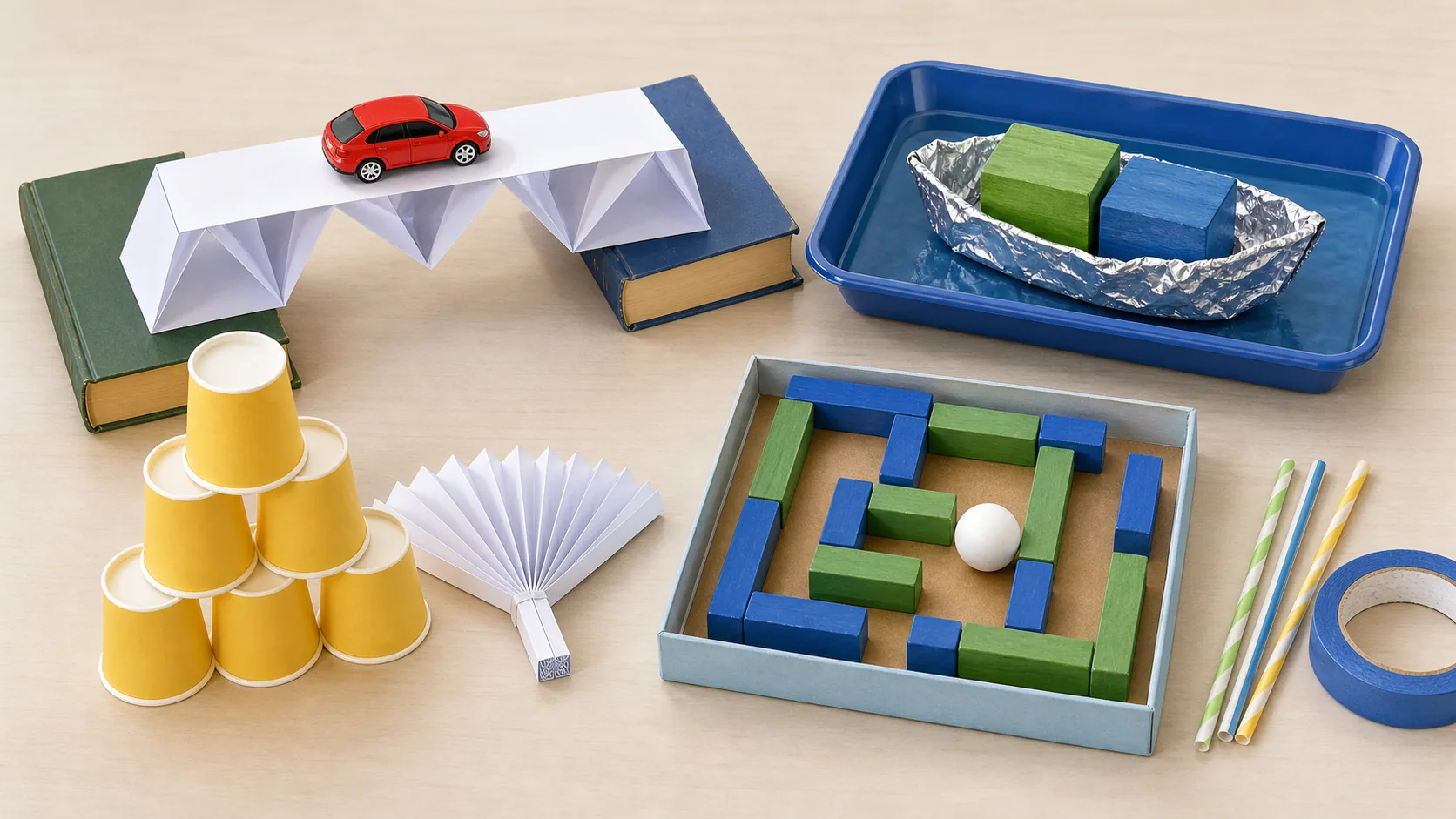
Illustration of possible setups. This is not a Kid Activity Lab family-test photo.
Handle cutting or tape and leave the layout decisions to the child.
A preschool engineering loop
Use the same loop for every challenge. The five-part structure is adapted from TERC Head Start on Engineering and HeadStart.gov; the short prompts are Kid Activity Lab editorial wording.
AskWhat must the build do?
ImagineName or draw more than one possible idea.
PlanChoose materials and one idea to try first.
Create and testBuild it, then run the visible test.
ImproveChange one part using what the test showed.
Nine challenges
Choose one problem to solve
Run one test and one first change. The rescue is a smaller version, not a promise that the activity will fit every child.
Challenge
Paper Bridge
Kid mission: Build a paper road that carries the car across the gap.
Editorial range: ages 4-6
Needone sheet of paper, two low books, one toy car
Adult setup: Place two low, stable books on the floor and keep them from sliding.
Lay the paper across the books.
Send the car across once.
Look at where the paper bends.
TestCan the car cross without the paper dropping into the gap?
First changeFold the paper lengthwise once, then test the same car again.
If the build stallsMove the books closer together and keep the first sheet flat.
Stop: Stop if the books slide, the child climbs on them, or the paper test is no longer welcome.
Parent check: Keep the bridge on the floor and use books the child can lift only with help.
Kid mission: Watch an empty foil boat: does it stay upright, lean or let water in?
Editorial range: ages 4-6
Needfoil, shallow tray, water, towel; no cargo
Adult setup: Set the tray on a stable wipeable surface with a towel beneath; control the water and stay beside it throughout. Open the linked folds and diagram before starting.
Raise all four foil edges; pinch corners without cutting.
Adult lowers the empty boat and checks it floats clear of the tray bottom and sides.
Watch, then ask the adult to lift it out before a change.
TestIs it floating freely, rather than resting on the tray? No cargo-capacity test here.
First changeAdult lifts and drains onto the towel; try raising one low edge or flattening an uneven bottom.
If the build stallsReplace torn foil or stop. If it cannot float freely in the shallow setup, choose a dry activity, not a deeper vessel.
Stop: Stop for mouthing, torn foil, spills, a moving tray, lost attention or wanting to leave.
Parent check: Adult gathers foil, empties and stores the tray, and wipes spills before leaving. Shallow water still requires continuous adult supervision. Watching is an option; no family testing or safety outcome is claimed.
Kid mission: Make a path that lets the ball travel from one corner to the opposite corner.
Editorial range: ages 4-6
Needshallow intact box lid, three chunky blocks, one large lightweight foam ball
Adult setup: Choose pieces for every child who can reach the setup, keep the lid below face level, and stay beside it. The adult controls when the ball enters and leaves the lid.
Build a wide path with three chunky block walls.
Ask the adult to place the ball in one corner.
Tilt gently, then put the lid flat for the adult to remove the ball.
TestCan the ball reach the opposite corner without getting trapped?
First changeMove one wall to open the place where the ball stopped.
If the build stallsUse only three walls and make a wide path first.
Stop: Stop if the ball or a block goes in a mouth, is thrown, or leaves the clear area; if the lid is shaken or lifted near a face; or if any material is damaged.
Parent check: The adult keeps the ball and spare blocks out of reach between runs and removes the ball first at cleanup. This editorial setup is not a safety assurance.
These sources support an iterative problem-solving model for young children. They do not establish that Kid Activity Lab ran these exact setups or measured their fit, safety, engagement, or learning outcomes.